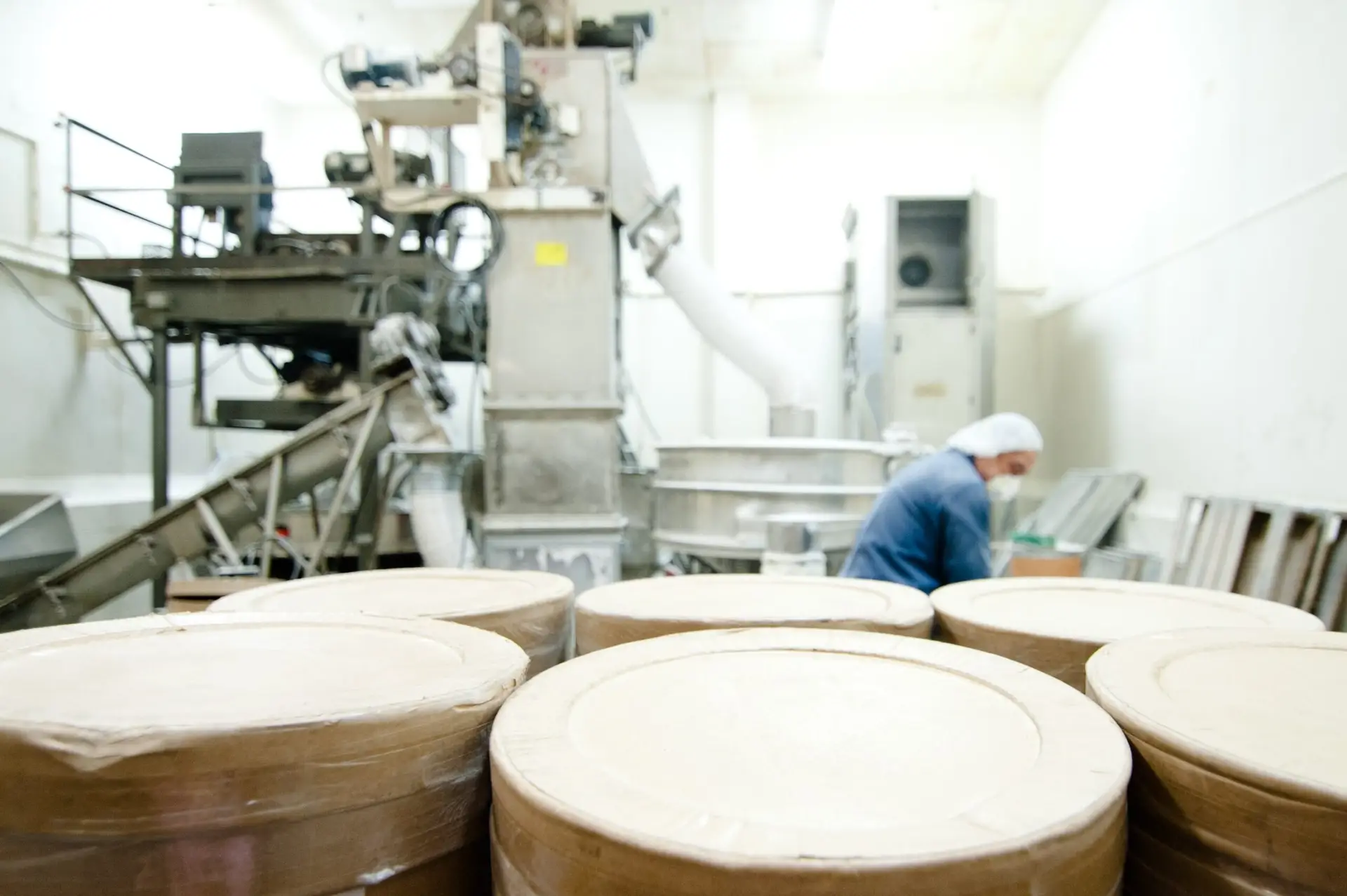
Toll Compaction has 5 processing rooms in the NJ plant used for dry granulation, three of which are dedicated to food and nutritional products.
There are 4 rooms in WV dedicated to dry granulation of powdered chemicals. Each room at both facilities has its own air, water, ventilation, dust collection system, and drainage to reduce the possibilities of cross contamination. All roller compactors are manufactured by The Fitzpatrick Company and all equipment has stainless steel contact parts. We have extensive experience dry granulating various polymer additives, specialty chemicals, functional foods, excipients, etc.
Why Dry Granulation?
To create a desired particle size. Through dry granulation, you can take a powder, increase the particle size, and control the distribution of the particle size.
For blending similar products. Some customers need to blend different materials that vary in particle size. By matching particle sizes, they can achieve a uniform blend.
To improve product flow. Powders tend to tunnel and cake. A granular product allows your product to flow freely through your production process.
To increase/decrease bulk density. By controlling the bulk density, you can control the flow and metering ability of a product.
To control particle hardness. Particle hardness can affect the dissolution and dispersion rates of a product. Also, the hardness of a particle helps to limit the disintegration of the product when being pneumatically or mechanically conveyed. By varying the pressure of the rolls in the chilsonator, we can improve the performance of a product.
To reduce dust. A dusty work environment is not only a nuisance but can pose a serious health and explosion risk. A granular product significantly reduces dusting.
Cost. Dry granulation is a more cost-effective process than wet granulation.
Packaging/Testing
Toll can discharge from and process into drums, PE bags, sewn bags, valve bags, gaylords, supersacks, etc. Testing includes sieve analysis, bulk density, and LOD.
Who provides toll granulation services for pharmaceutical companies?
Toll granulation services for pharmaceutical companies are provided by specialized companies like Toll Compaction, which focuses on efficient manufacturing processes tailored to the needs of the pharmaceutical industry.
What are the benefits of using toll granulation services?
The benefits of using toll granulation services include enhanced product consistency, improved flow properties, reduced dust generation, and the ability to scale production without significant capital investment. These services also offer flexibility and expertise tailored to specific industry needs.
How toll compaction services save logistics costs?
Toll compaction services save logistics costs by optimizing product density, allowing for more efficient transportation and storage. This reduces shipping expenses and minimizes the need for excess packaging, ultimately streamlining the supply chain.
How does toll compaction process reduce settlement?
The toll compaction process effectively reduces settlement by creating denser granules through controlled pressure application, which enhances product stability and flowability, minimizing separation and settling during storage and transportation.
How does toll granulation ensure product uniformity?
Toll granulation ensures product uniformity through precise control of the granulation process, utilizing advanced equipment and standardized parameters. This consistency in processing leads to uniform particle size and distribution, enhancing the quality and performance of the final product.
Can toll granulation be used for small batch production?
Toll granulation can indeed be used for small batch production. Our facilities are equipped to handle varying batch sizes, allowing for flexibility to meet specific client needs in the food, nutritional, and chemical industries.
What is the definition of toll granulation in the pharmaceutical industry?
The definition of toll granulation in the pharmaceutical industry is a contract manufacturing process where a third-party service provider, known as a toll manufacturer, performs granulation for pharmaceutical companies, enhancing the flow and consistency of powdered ingredients for tablet production.
Are toll granulation services regulated by industry standards?
Toll granulation services are regulated by industry standards to ensure quality and safety in manufacturing. Compliance with these standards is essential for maintaining product integrity across various sectors, including food, nutritional, and chemical industries.
What are the benefits of toll compaction services?
The benefits of toll compaction services include enhanced product flow, reduced dust generation, and improved material stability. These services also allow for customized formulations and efficient scaling of production, meeting the specific needs of various industries.
What is the purpose of toll compaction services?
The purpose of toll compaction services is to provide efficient manufacturing solutions that transform powders into granules, enhancing product flow, reducing dust, and ensuring consistent quality for clients in various industries such as food, nutrition, and chemicals.
What materials are suitable for toll granulation?
The materials suitable for toll granulation include a variety of powders and granules from the food, nutritional, and chemical industries. Common examples are sugars, starches, and various excipients that benefit from enhanced flow and reduced dust.
How is quality controlled in toll granulation?
Quality control in toll granulation is ensured through rigorous testing and monitoring of materials throughout the process, utilizing advanced equipment and adhering to industry standards to guarantee consistency and product integrity.
What industries benefit from toll compaction services?
Various industries benefit from toll compaction services, including food, nutritional, and chemical sectors, where enhanced product flow, reduced dust, and efficient processing are essential for manufacturing high-quality products.
What equipment is used for toll granulation?
The equipment used for toll granulation includes high-shear granulators, fluid bed dryers, and roller compactors, which effectively process materials to achieve desired granule size and density while enhancing product flow and minimizing dust.
How do toll granulation services enhance product consistency?
Toll granulation services enhance product consistency by utilizing precise processing techniques and advanced equipment that ensure uniform particle size and distribution. This results in improved flow properties and reduced variability, leading to a more reliable end product.
What is the typical lead time for toll services?
The typical lead time for toll services varies depending on the specific project requirements and current workload, but generally ranges from a few days to several weeks. Please contact us for a more precise estimate tailored to your needs.
How does toll compaction affect final product quality?
Toll compaction significantly enhances final product quality by improving particle size distribution, flowability, and reducing dust generation. This process ensures consistent and uniform granules, leading to better performance in applications across various industries.
What are the typical costs associated with toll granulation?
The typical costs associated with toll granulation vary based on factors such as the scale of production, the complexity of the formulation, and the specific equipment used. It's best to consult with Toll Compaction for a tailored estimate.
Are there size limitations for toll granulation projects?
Size limitations for toll granulation projects vary based on equipment and material specifications. At Toll Compaction, we can accommodate a wide range of project sizes to meet your specific needs.
How scalable are toll compaction services for production?
Toll Compaction services are highly scalable for production, accommodating a range of batch sizes to meet varying client needs efficiently. Our advanced equipment and facilities in New Jersey and West Virginia ensure flexibility and responsiveness in scaling operations.
What certifications do toll granulation facilities hold?
Toll granulation facilities hold various certifications to ensure quality and compliance, including ISO 9001 for quality management and cGMP (current Good Manufacturing Practices) certifications, which guarantee adherence to industry standards in manufacturing processes.
How does toll granulation improve product shelf life?
Toll granulation improves product shelf life by enhancing stability and reducing moisture absorption. This process creates uniform granules that minimize degradation, ensuring products maintain their quality and efficacy over extended periods.
What technical support is available for toll services?
Technical support available for toll services includes expert consultation, process optimization assistance, and troubleshooting for equipment and operations, ensuring efficient and effective manufacturing processes tailored to client needs.
What is the process for starting toll granulation?
The process for starting toll granulation involves contacting Toll Compaction to discuss your specific needs, followed by a consultation to evaluate your materials and requirements, and finally setting up a trial run to ensure optimal results.
How can companies ensure compliance with granulation standards?
Companies can ensure compliance with granulation standards by implementing rigorous quality control measures, adhering to industry regulations, utilizing validated processes, and conducting regular audits to maintain consistency and product quality throughout the granulation process.
In what ways does toll compaction improve efficiency?
Toll Compaction improves efficiency through advanced dry granulation techniques that enhance product flow, minimize dust, and streamline production processes. This results in faster turnaround times and reduced operational costs for clients in various industries.
What are common challenges in toll granulation services?
Common challenges in toll granulation services include achieving consistent particle size, managing moisture content, and ensuring compatibility of materials. Additionally, maintaining quality control and adhering to regulatory standards can complicate the granulation process.
Can toll granulation be customized for specific products?
Toll granulation can be customized for specific products. Our processes are adaptable to meet the unique requirements of various materials, ensuring optimal results tailored to your product's characteristics and performance needs.
How often is equipment maintained in toll services?
Equipment maintenance in toll services is conducted regularly, typically following a scheduled program that includes routine checks and preventive measures to ensure optimal performance and safety.
What environmental considerations are involved in toll processing?
Environmental considerations in toll processing include minimizing waste, reducing emissions, and ensuring compliance with regulations. Companies like Toll Compaction prioritize sustainable practices to lessen their ecological footprint while maintaining product quality.
chilsonator dry granulation, toll granulation, toll compaction, toll compaction services, toll compaction neptune nj, dry granulation equipment, toll compaction washington wv, contract drying services for specialty chemicals, toll drum drying company, toll conversion of liquid to dry chemical, chemical dry repacking, dry granulator, roll compactor contract manufacturing
Understanding the Dry Granulation Process
The dry granulation process is a key technique used in the manufacturing of various powdered products, particularly in the food, nutritional, and chemical industries. This method involves compacting fine powders into granules without the use of liquid binders, which can alter the product's characteristics. By applying pressure, the process improves the flowability and consistency of the final product, making it suitable for further processing or packaging.
In dry granulation, materials are typically fed into a roller compactor where they are subjected to high pressure. The resulting granules are then milled to achieve the desired particle size distribution. This method is particularly advantageous for heat-sensitive materials that could degrade if exposed to moisture or heat, ensuring the integrity of the product is maintained throughout the manufacturing process.
Equipment and Technology Used in Dry Granulation
Toll Compaction employs state-of-the-art equipment to ensure efficient and effective dry granulation. Our facilities are equipped with advanced roller compactors and milling machines that are designed for precision and reliability. This technology allows us to handle a wide range of materials, including polymers and specialty chemicals, while maintaining strict quality control throughout the process.
Benefits of Choosing Toll Compaction for Dry Granulation
Choosing Toll Compaction for dry granulation services offers numerous benefits, including improved product quality and efficiency. Our expertise in toll manufacturing allows us to tailor our services to meet the specific needs of each client, ensuring optimal results. By utilizing our dry granulation process, clients can expect enhanced flow properties, reduced dust generation, and better handling characteristics of their powdered products.
Additionally, our strategic locations in New Jersey and West Virginia provide convenient access to clients across various industries. With our commitment to quality and customer satisfaction, we are dedicated to helping businesses achieve their production goals while maintaining the highest standards of safety and compliance.
Quality Control Measures in Dry Granulation
At Toll Compaction, we prioritize quality control in every aspect of our dry granulation services. Our facilities are equipped with rigorous testing protocols that include sieve analysis, bulk density measurements, and loss on drying (LOD) assessments. These tests ensure that the granules produced meet the specific requirements of our clients and comply with industry regulations.
Who provides toll granulation services for pharmaceutical companies?
Toll granulation services for pharmaceutical companies are provided by specialized companies like Toll Compaction, which focuses on efficient manufacturing processes tailored to the needs of the pharmaceutical industry.
What are the benefits of using toll granulation services?
The benefits of using toll granulation services include enhanced product consistency, improved flow properties, reduced dust generation, and the ability to scale production without significant capital investment. These services also offer flexibility and expertise tailored to specific industry needs.
How toll compaction services save logistics costs?
Toll compaction services save logistics costs by optimizing product density, allowing for more efficient transportation and storage. This reduces shipping expenses and minimizes the need for excess packaging, ultimately streamlining the supply chain.
How does toll compaction process reduce settlement?
The toll compaction process effectively reduces settlement by creating denser granules through controlled pressure application, which enhances product stability and flowability, minimizing separation and settling during storage and transportation.
How does toll granulation ensure product uniformity?
Toll granulation ensures product uniformity through precise control of the granulation process, utilizing advanced equipment and standardized parameters. This consistency in processing leads to uniform particle size and distribution, enhancing the quality and performance of the final product.
Can toll granulation be used for small batch production?
Toll granulation can indeed be used for small batch production. Our facilities are equipped to handle varying batch sizes, allowing for flexibility to meet specific client needs in the food, nutritional, and chemical industries.
What is the definition of toll granulation in the pharmaceutical industry?
The definition of toll granulation in the pharmaceutical industry is a contract manufacturing process where a third-party service provider, known as a toll manufacturer, performs granulation for pharmaceutical companies, enhancing the flow and consistency of powdered ingredients for tablet production.
Are toll granulation services regulated by industry standards?
Toll granulation services are regulated by industry standards to ensure quality and safety in manufacturing. Compliance with these standards is essential for maintaining product integrity across various sectors, including food, nutritional, and chemical industries.
What are the benefits of toll compaction services?
The benefits of toll compaction services include enhanced product flow, reduced dust generation, and improved material stability. These services also allow for customized formulations and efficient scaling of production, meeting the specific needs of various industries.
What is the purpose of toll compaction services?
The purpose of toll compaction services is to provide efficient manufacturing solutions that transform powders into granules, enhancing product flow, reducing dust, and ensuring consistent quality for clients in various industries such as food, nutrition, and chemicals.
What materials are suitable for toll granulation?
The materials suitable for toll granulation include a variety of powders and granules from the food, nutritional, and chemical industries. Common examples are sugars, starches, and various excipients that benefit from enhanced flow and reduced dust.
How is quality controlled in toll granulation?
Quality control in toll granulation is ensured through rigorous testing and monitoring of materials throughout the process, utilizing advanced equipment and adhering to industry standards to guarantee consistency and product integrity.
What industries benefit from toll compaction services?
Various industries benefit from toll compaction services, including food, nutritional, and chemical sectors, where enhanced product flow, reduced dust, and efficient processing are essential for manufacturing high-quality products.
What equipment is used for toll granulation?
The equipment used for toll granulation includes high-shear granulators, fluid bed dryers, and roller compactors, which effectively process materials to achieve desired granule size and density while enhancing product flow and minimizing dust.
How do toll granulation services enhance product consistency?
Toll granulation services enhance product consistency by utilizing precise processing techniques and advanced equipment that ensure uniform particle size and distribution. This results in improved flow properties and reduced variability, leading to a more reliable end product.
What is the typical lead time for toll services?
The typical lead time for toll services varies depending on the specific project requirements and current workload, but generally ranges from a few days to several weeks. Please contact us for a more precise estimate tailored to your needs.
How does toll compaction affect final product quality?
Toll compaction significantly enhances final product quality by improving particle size distribution, flowability, and reducing dust generation. This process ensures consistent and uniform granules, leading to better performance in applications across various industries.
What are the typical costs associated with toll granulation?
The typical costs associated with toll granulation vary based on factors such as the scale of production, the complexity of the formulation, and the specific equipment used. It's best to consult with Toll Compaction for a tailored estimate.
Are there size limitations for toll granulation projects?
Size limitations for toll granulation projects vary based on equipment and material specifications. At Toll Compaction, we can accommodate a wide range of project sizes to meet your specific needs.
How scalable are toll compaction services for production?
Toll Compaction services are highly scalable for production, accommodating a range of batch sizes to meet varying client needs efficiently. Our advanced equipment and facilities in New Jersey and West Virginia ensure flexibility and responsiveness in scaling operations.
What certifications do toll granulation facilities hold?
Toll granulation facilities hold various certifications to ensure quality and compliance, including ISO 9001 for quality management and cGMP (current Good Manufacturing Practices) certifications, which guarantee adherence to industry standards in manufacturing processes.
How does toll granulation improve product shelf life?
Toll granulation improves product shelf life by enhancing stability and reducing moisture absorption. This process creates uniform granules that minimize degradation, ensuring products maintain their quality and efficacy over extended periods.
What technical support is available for toll services?
Technical support available for toll services includes expert consultation, process optimization assistance, and troubleshooting for equipment and operations, ensuring efficient and effective manufacturing processes tailored to client needs.
What is the process for starting toll granulation?
The process for starting toll granulation involves contacting Toll Compaction to discuss your specific needs, followed by a consultation to evaluate your materials and requirements, and finally setting up a trial run to ensure optimal results.
How can companies ensure compliance with granulation standards?
Companies can ensure compliance with granulation standards by implementing rigorous quality control measures, adhering to industry regulations, utilizing validated processes, and conducting regular audits to maintain consistency and product quality throughout the granulation process.
In what ways does toll compaction improve efficiency?
Toll Compaction improves efficiency through advanced dry granulation techniques that enhance product flow, minimize dust, and streamline production processes. This results in faster turnaround times and reduced operational costs for clients in various industries.
What are common challenges in toll granulation services?
Common challenges in toll granulation services include achieving consistent particle size, managing moisture content, and ensuring compatibility of materials. Additionally, maintaining quality control and adhering to regulatory standards can complicate the granulation process.
Can toll granulation be customized for specific products?
Toll granulation can be customized for specific products. Our processes are adaptable to meet the unique requirements of various materials, ensuring optimal results tailored to your product's characteristics and performance needs.
How often is equipment maintained in toll services?
Equipment maintenance in toll services is conducted regularly, typically following a scheduled program that includes routine checks and preventive measures to ensure optimal performance and safety.
What environmental considerations are involved in toll processing?
Environmental considerations in toll processing include minimizing waste, reducing emissions, and ensuring compliance with regulations. Companies like Toll Compaction prioritize sustainable practices to lessen their ecological footprint while maintaining product quality.
chilsonator dry granulation, toll granulation, toll compaction, toll compaction services, toll compaction neptune nj, dry granulation equipment, toll compaction washington wv, contract drying services for specialty chemicals, toll drum drying company, toll conversion of liquid to dry chemical, chemical dry repacking, dry granulator, roll compactor contract manufacturing
Understanding the Dry Granulation Process
The dry granulation process is a key technique used in the manufacturing of various powdered products, particularly in the food, nutritional, and chemical industries. This method involves compacting fine powders into granules without the use of liquid binders, which can alter the product's characteristics. By applying pressure, the process improves the flowability and consistency of the final product, making it suitable for further processing or packaging.
In dry granulation, materials are typically fed into a roller compactor where they are subjected to high pressure. The resulting granules are then milled to achieve the desired particle size distribution. This method is particularly advantageous for heat-sensitive materials that could degrade if exposed to moisture or heat, ensuring the integrity of the product is maintained throughout the manufacturing process.
Equipment and Technology Used in Dry Granulation
Toll Compaction employs state-of-the-art equipment to ensure efficient and effective dry granulation. Our facilities are equipped with advanced roller compactors and milling machines that are designed for precision and reliability. This technology allows us to handle a wide range of materials, including polymers and specialty chemicals, while maintaining strict quality control throughout the process.
Benefits of Choosing Toll Compaction for Dry Granulation
Choosing Toll Compaction for dry granulation services offers numerous benefits, including improved product quality and efficiency. Our expertise in toll manufacturing allows us to tailor our services to meet the specific needs of each client, ensuring optimal results. By utilizing our dry granulation process, clients can expect enhanced flow properties, reduced dust generation, and better handling characteristics of their powdered products.
Additionally, our strategic locations in New Jersey and West Virginia provide convenient access to clients across various industries. With our commitment to quality and customer satisfaction, we are dedicated to helping businesses achieve their production goals while maintaining the highest standards of safety and compliance.
Quality Control Measures in Dry Granulation
At Toll Compaction, we prioritize quality control in every aspect of our dry granulation services. Our facilities are equipped with rigorous testing protocols that include sieve analysis, bulk density measurements, and loss on drying (LOD) assessments. These tests ensure that the granules produced meet the specific requirements of our clients and comply with industry regulations.