
Last Updated:
If you produce or supply polymer additives, you already know the problems: powders that dust excessively, flow poorly through equipment, pack inconsistently into packaging, and disperse unevenly in downstream compounding. These are not edge cases. They affect every production run. The real question is: does roller compaction actually solve them, or is it just adding another step to an already complicated process?
Quick Answer: How Roller Compaction Helps Polymer Additive Processing
- Yes, roller compaction directly solves the three biggest polymer additive processing problems: poor flowability, excessive dust, and inconsistent bulk density.
- It is a dry granulation method that compacts fine powder into dense granules without heat, solvents, or binders, preserving material chemistry entirely.
- It is ideal for heat-sensitive and moisture-sensitive additives including antioxidants, stabilizers, UV absorbers, and flame retardants.
- Toll Compaction uses Fitzpatrick roller compactors at its dedicated WV facility for polymer additive and industrial chemical processing.
- Granulated polymer additives disperse more uniformly in compounding and reduce workplace dust by 80 to 95 percent versus raw powder.
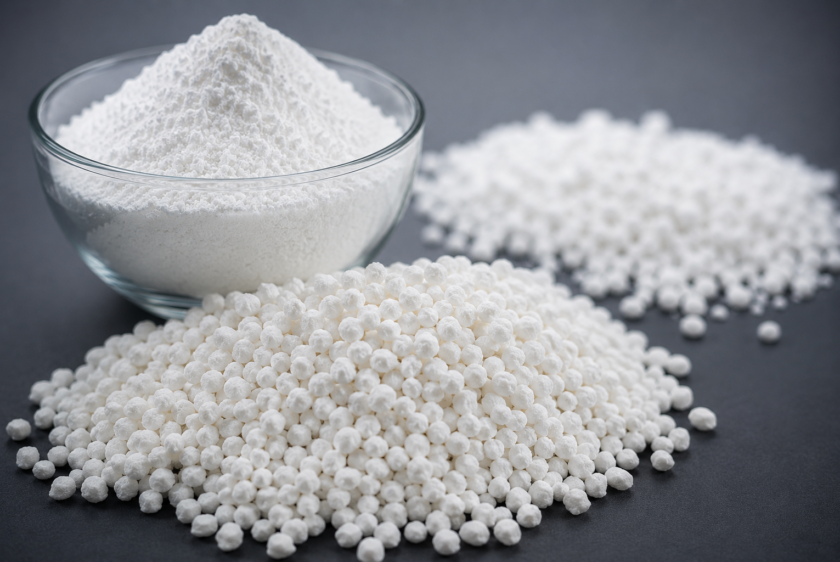
Roller compaction is a continuous dry granulation process in which fine powder is fed between two counter-rotating rollers under controlled pressure. The rollers compress the powder into a dense ribbon or flake, which is then milled and screened to produce a uniform granule at the target particle size distribution. No liquids, solvents, or binders are used at any point in the process, and no drying step is required. For polymer additives, this matters enormously, because wet granulation methods introduce moisture and heat that degrade thermally sensitive antioxidants, stabilizers, and other functional compounds.
Why Polymer Additive Powders Are Difficult to Process
- Poor flowability: fine particles create high surface contact and cohesive forces, causing bridging, arching, and rat-holing inside hoppers and feeders, leading to uneven feed rates and dosing errors during compounding.
- Excessive dust: airborne fine polymer additive powder creates respiratory and environmental hazards, increases material loss, and creates explosive dust conditions in facilities handling certain organic compounds.
- Segregation during blending: ultra-fine particles in a mixed formulation tend to segregate from coarser components, compromising blend uniformity and batch consistency.
- Low bulk density: fine powders occupy significantly more volume per unit weight, increasing packaging, storage, and freight costs for manufacturers and distributors.
- Poor dispersion in compounding: unprocessed fine powders agglomerate inside the extruder, leading to inconsistent performance in the finished plastic.
How Roller Compaction Solves These Problems
- Improved flowability: compacted granules are larger, denser, and more spherical. They flow freely through hoppers, feeders, and metering equipment, enabling accurate and consistent dosing in compounding operations.
- Dust reduction of 80 to 95 percent: the compaction process binds fine particles into robust granules that do not break apart under normal handling, dramatically reducing airborne dust and material loss.
- Controlled bulk density: compaction pressure and roller gap can be dialed in to a target bulk density, ensuring consistent fill weights, packaging performance, and dosing accuracy across batches.
- Improved blend uniformity: granulating a multi-component additive blend before packaging locks components together and prevents segregation during transport.
- Better dispersion in the polymer matrix: granules produced through roller compaction break down more uniformly in the extruder, leading to more consistent distribution of the additive in the finished compound.
Polymer Additive Types That Benefit from Roller Compaction
- Antioxidants including hindered phenolics and phosphites
- Heat stabilizers for PVC and engineering plastics
- UV absorbers and HALS light stabilizers
- Flame retardants including phosphorus-based and mineral-based systems
- Lubricants and internal processing aids
- Nucleating agents and clarifiers
- Slip agents and anti-block compounds
- Combined additive packages and masterbatch precursor blends
Roller Compaction vs. Wet Granulation for Polymer Additives
Wet granulation introduces solvents and heat that can degrade thermally sensitive organic compounds. It also requires a drying step, adding processing time and energy cost. Dry roller compaction eliminates all of these risks. There are no binders, no liquids, no drying, and no change to the chemistry of the material. For polymer additives, dry granulation is almost always the correct method.
Equipment and Facilities at Toll Compaction
Toll Compaction uses Fitzpatrick roller compactors with stainless steel contact parts at its Washington, West Virginia facility, which has four independent dry granulation rooms dedicated to polymer additive and industrial chemical processing. Each room operates with its own ventilation, dust collection, and drainage to prevent cross-contamination between products. The NJ and WV locations give polymer additive suppliers East Coast access with faster turnaround than Midwest or offshore processors.
Ready to improve your polymer additive processing? Contact Toll Compaction to discuss your material requirements and request a quote.


