
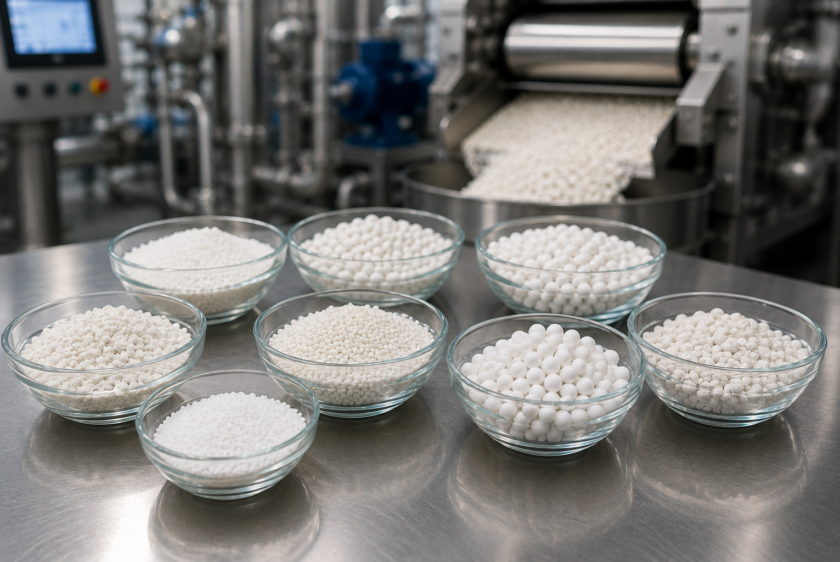
Pharmaceutical excipients and functional food ingredients are both sold as powders, both need to meet tight specifications, and both end up in products that consumers put in their bodies. So why do so many ingredient suppliers treat processing as an afterthought? The particle size of your excipient affects whether a tablet compresses or caps. The flowability of your functional food powder affects whether a beverage manufacturer can even run it on their line. The question is not whether precision processing matters for these materials. It is whether your current processing approach is delivering the precision your customers actually need.
Quick Answer: Why Precision Matters in Excipient and Food Ingredient Processing
- Particle size, bulk density, and flowability directly affect the performance of excipients in tableting and functional food ingredients in finished products.
- A poorly processed excipient causes tablet capping, weight variation, and dissolution failures. A poorly processed food ingredient clumps, flows poorly, and underdelivers in the food system.
- Toll Compaction’s NJ facility is FSSC 22000, ISO 9001:2015, GMP, and Kosher certified for food-grade processing.
- Three of five NJ granulation rooms are dedicated exclusively to food, nutritional, and excipient materials, fully separated from chemical processing.
- Services include dry granulation, blending, size reduction, screening, and repackaging, all with full batch documentation and COAs.
The processing of pharmaceutical excipients and functional food ingredients is not simply a matter of applying standard powder processing to food-grade materials. It requires dedicated, certified infrastructure, experienced operators who understand the performance requirements of food-adjacent compounds, and a quality management system that produces the documentation trail your customers require. Toll Compaction’s New Jersey facility serves excipient manufacturers, functional food ingredient suppliers, dietary supplement brands, and nutraceutical producers with certified, dedicated processing capacity.
What Are Excipients and Why Does Processing Affect Performance?
In pharmaceutical and supplement manufacturing, an excipient is any inactive ingredient combined with an active compound to form the final product. Excipients serve as binders, fillers, disintegrants, lubricants, flow aids, and coating agents. Their physical properties, particularly particle size, bulk density, flowability, and compressibility, directly determine the performance of the finished tablet or capsule. A poorly processed excipient causes tablet capping, sticking, weight variation, slow dissolution, and reduced bioavailability. These are regulatory and product quality failures, not cosmetic issues.
What Are Functional Food Ingredients and Why Do They Need Precision Processing?
Functional food ingredients are bioactive compounds added to food products to deliver a health benefit beyond basic nutrition: prebiotic fibers, plant-based protein concentrates, vitamin and mineral premixes, botanical extracts, antioxidant compounds, and probiotics. They are typically sold as powders or granules to food manufacturers who incorporate them into beverages, energy bars, cereals, dairy products, and functional snacks. The physical form of the ingredient, its particle size, flowability, and dispersibility, determines how it behaves in the food system and how easy it is to work with in production. An ingredient that clumps, flows inconsistently, or disperses poorly costs your customer money and damages your relationship.
Certifications at Toll Compaction’s NJ Facility for Food-Grade Processing
- FSSC 22000: the internationally recognized food safety management standard covering ISO 22000:2018 and ISO/TS 22002-1:2009.
- ISO 9001:2015 Quality Management System certification.
- GMP Facility certification for food manufacturing.
- Kosher certification.
- FDA registration for food manufacturing operations.
Dedicated Food-Grade Processing Rooms: Why Physical Separation Matters
Toll Compaction’s NJ facility has five dry granulation rooms. Three are dedicated exclusively to food, nutritional, and excipient processing, physically separated from the chemical processing areas. These rooms operate with their own independent ventilation, dust collection, drainage, and cleaning systems. This eliminates cross-contamination risk between food-grade ingredients and industrial chemical materials, which is not optional for excipient manufacturers and food ingredient suppliers working in regulated environments.
Processing Services Available for Excipients and Functional Food Ingredients
- Dry granulation and roller compaction for direct compression excipients and supplement ingredient powders
- Precision blending of multi-component vitamin, mineral, and botanical formulations using stainless steel ribbon blenders
- Size reduction via Fitzmill and air classifier mill for fine particle size targets in food-grade applications
- Screening and classification to tight mesh specifications
- Repackaging into food-grade bags, fiber drums, supersacks, and pails with full batch documentation
- Pelletizing for functional food ingredients requiring a denser, more flowable pellet form
- Certificate of analysis and full batch records for all processed material
Who Uses Toll Processing for Excipients and Functional Food Ingredients?
- Pharmaceutical excipient manufacturers needing certified contract processing capacity for production overflow or new product development.
- Functional food ingredient suppliers converting bulk commodity powders into market-ready granular or pellet forms.
- Dietary supplement brands that source actives in bulk and need blending, granulation, or size reduction before encapsulation or tableting.
- Nutraceutical companies developing new ingredient formats for direct-to-consumer supplement products.
- Food manufacturers requiring a custom blended premix of vitamins, minerals, or functional ingredients.
One Certified Toll Processor for Both Industrial and Food-Grade Needs
Toll Compaction’s dual-facility structure, with dedicated chemical processing at WV and dedicated food-grade processing at NJ, allows customers to consolidate their toll processing relationships without compromising the separation and certification requirements of their food-grade programs. Most processors specialize in either industrial chemicals or food and pharma. The infrastructure and certifications at Toll Compaction support both, under one company, with clear physical and procedural separation between them.
Need certified food-grade processing for your excipient or functional food ingredient? Contact Toll Compaction to discuss your specifications and request a quote.


