Last Updated:
Blending is one of the most common operations in industrial chemical manufacturing, but it is not always the most efficient one to run in-house. If your blending equipment is constantly tied up, your capacity spikes seasonally, or you are trying to bring a new formulation to market without committing to production-scale infrastructure, the question worth asking is: would outsourcing your blending to a toll processor actually save you time and money, and what would that arrangement look like?
Quick Answer: What Is Toll Blending and When Does It Make Sense?
- Toll blending is outsourcing your powder blending operation to a contract processor who uses their own equipment, facility, and operators while you supply the raw materials and formula.
- It makes sense when you lack equipment, face capacity constraints, need trial blends, or want to avoid the cost and complexity of running an in-house blending program.
- You retain full ownership of your formulation throughout. The toll blender provides only the processing service.
- Toll Compaction blends industrial chemicals, polymer additives, minerals, and food-grade ingredients using stainless steel ribbon blenders at NJ and WV facilities.
- Both facilities are ISO 9001:2015 certified with validated cleaning procedures to prevent cross-contamination between products.
Toll blending is a contract arrangement in which a specialized processor blends two or more materials together according to your formulation or specification. You provide the raw materials, the formula, and the target blend ratios. The toll blender performs the operation, conducts quality checks, packages the finished blend, and returns or ships the product as directed. You retain full ownership of your materials and formulation throughout. The toll processor provides only equipment, labor, facility, and expertise.
What Equipment Is Used for Industrial Chemical Toll Blending?
- Ribbon blenders: horizontal blending vessels with a double-helix ribbon agitator that moves material both radially and axially. Well-suited for free-flowing powders and granules in batch quantities from a few hundred to several thousand pounds.
- Paddle blenders: gentler blending for fragile granules or materials that require minimal attrition.
- Tumble and V-blenders: rotating vessel blenders ideal for free-flowing materials where contamination risk must be minimized.
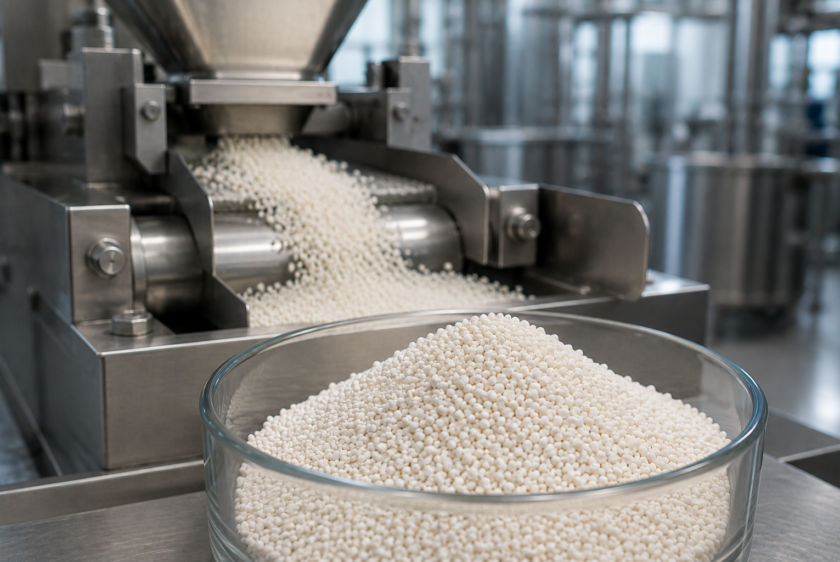
Toll Compaction uses stainless steel ribbon blenders at both NJ and WV facilities. All contact parts are stainless steel. Each product run is followed by a validated cleaning procedure to prevent cross-contamination between batches.
When Toll Blending Makes More Sense Than In-House
- You do not own blending equipment and the capital cost of purchasing, installing, and maintaining a blender is not justified by your current production volume.
- You have seasonal demand spikes that exceed your in-house capacity without requiring year-round investment in additional equipment.
- You are developing a new product and need trial blends at various ratios before committing to a production-scale program.
- Your in-house equipment is fully committed to other products and you need overflow capacity.
- You need dedicated equipment for a specific product that cannot share equipment with others due to contamination concerns.
- Your facility is not equipped for the material, for example if the product has combustible dust characteristics or requires food-grade handling.
- You want to reduce labor, overhead, and compliance costs associated with operating an in-house blending operation.
Materials Toll Compaction Blends
- Industrial non-hazardous chemical formulations and multi-component blends
- Polymer additive packages combining antioxidants, stabilizers, lubricants, and other functional additives
- Mineral blends and raw material combinations for industrial, agricultural, or construction applications
- Water treatment chemical formulations
- Agrochemical and fertilizer blends
- Functional food and dietary supplement ingredient pre-blends at our FSSC 22000 certified NJ facility
Toll Blending vs. Contract Manufacturing: What Is the Difference?
In toll blending, you supply the raw materials and the formula. The toll blender provides only the processing service. In contract manufacturing, the manufacturer typically sources raw materials on your behalf and manages a broader scope of production. For companies that want to protect their formulations and supply chain relationships while outsourcing only the processing step, toll blending is the preferred structure.
How to Get Started with a Toll Blending Program
Getting started typically involves sharing your formulation or blend specification, providing a sample of your raw materials for a trial blend, reviewing a certificate of analysis on the finished blend, and approving the process before committing to production volume. Toll Compaction works through a structured trial and approval process with new blending clients to ensure that finished blends meet your specification before scaling.
Ready to explore toll blending for your industrial chemical formulation? Contact Toll Compaction to discuss your materials and blending requirements.


