Last Updated:
You are selling a fine powder product and your customers keep asking if you can supply it in pellet form. Or your own production line is losing material to dust, struggling with inconsistent flow, or paying too much per shipment because the bulk density is too low. The question is whether pelletizing is actually the right answer for your material, and whether the benefits justify the added processing step.
Quick Answer: When Pelletizing Makes Sense for Industrial Powders
- Pelletizing makes sense when your powder has poor flowability, generates excessive dust, has low bulk density that increases freight costs, or when customers require a pellet form.
- It converts fine powder into dense, uniform pellets through compaction, improving handling, reducing dust, and increasing bulk density without changing material chemistry.
- It differs from granulation in that pellets are more uniform in shape and typically denser, making them better for precision dosing and field application.
- Suitable for industrial chemicals, polymer additives, minerals, water treatment chemicals, agricultural compounds, and food-grade ingredients.
- Toll Compaction provides toll pelletizing at NJ and WV facilities with capacity for development trials through full production volume.
Pelletizing is the process of compressing fine powder into dense, uniform pellets of controlled size. It is one of the most effective ways to transform the physical handling characteristics of a powdered material without altering its chemistry. For manufacturers working with industrial chemicals, polymer additives, minerals, and agricultural compounds, converting to a pellet form often solves multiple downstream problems at once: poor flow, excessive dust, low bulk density, and customer preference for a more consistent product form.
What Is Pelletizing and How Does It Differ from Granulation?
Pelletizing and granulation both convert fine powders into larger particles, but they differ in the consistency and density of the output:
- Granulation produces irregularly shaped agglomerates through compaction, wet processing, or fluid bed methods. Size and shape vary within a batch.
- Pelletizing produces highly uniform, cylindrical or spherical pellets of controlled size and density. The pellet form is more consistent and typically denser than granules.
For applications where dimensional uniformity matters, such as direct-feed systems, precision dosing equipment, or markets where product appearance matters to customers, pelletizing is preferred over standard granulation.
How Industrial Pelletizing Works
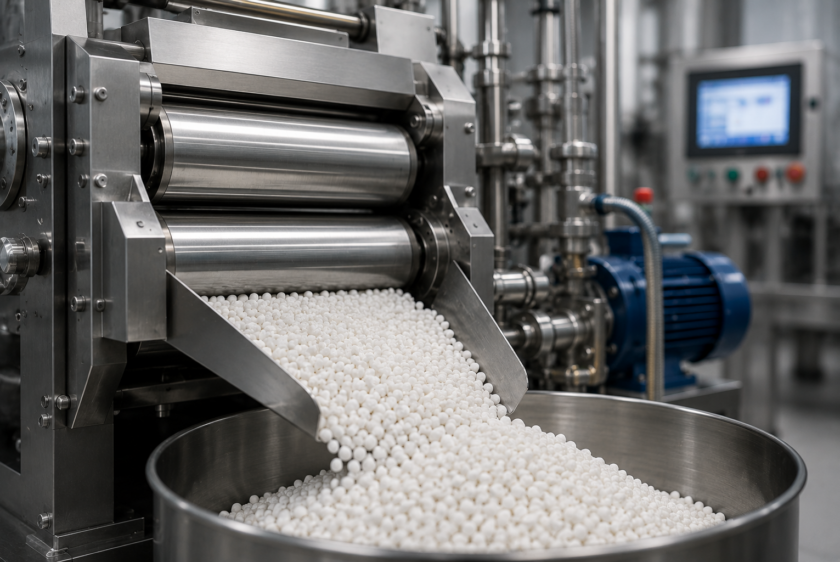
The pelletizing process feeds raw powder into a pellet press or compaction system that forces material through a die under controlled pressure, forming dense, uniform pellets of a target size. Depending on the material, a small amount of binder may be used to improve pellet integrity, though many industrial materials can be pelletized without any binder through dry compaction alone. Toll Compaction works with each client to establish optimal processing parameters on trial quantities before scaling to production volume.
Signs Pelletizing Is Right for Your Material
- Your powder dusts excessively during handling, packaging, or customer use, creating safety, environmental, or product loss problems.
- Your material has poor flowability causing inconsistent feed rates, bridging in hoppers, or dosing problems at the end user.
- Your powder has low bulk density that increases freight and packaging costs and reduces product per container.
- Your customer requires a pellet form for their processing equipment or application specifications.
- You are selling into agricultural, water treatment, or oilfield markets where pellet or granule forms are standard industry expectations.
- Your material needs to be handled by non-technical users who benefit from a more user-friendly form over loose powder.
Materials Suitable for Pelletizing at Toll Compaction
- Industrial non-hazardous chemicals and chemical intermediates
- Polymer additives including antioxidants, stabilizers, and flame retardants
- Mineral powders including carbonates, sulfates, and oxides
- Water treatment chemicals including coagulants and flocculants
- Agricultural chemicals including soil conditioners and micronutrients
- Oilfield chemical powders
- Functional food and nutritional ingredient powders at our FSSC 22000 certified NJ facility
Benefits of Pelletizing Across the Supply Chain
- Reduced dust and improved safety: pellets generate far less airborne dust than fine powders during handling, loading, and application.
- Improved flowability: pellets move freely through hoppers, feeders, augers, and metering equipment.
- Higher bulk density: pellets occupy less volume per unit weight, reducing freight costs and increasing product per container.
- Longer shelf life: pellets are less prone to caking, clumping, and moisture absorption than fine powders.
- Better customer experience: a pellet product is perceived as higher quality in many industrial markets.
- Reduced segregation: pelletizing a multi-component blend locks components together and prevents separation during transport.
Pelletizing as a Toll Service
Most industrial chemical and mineral producers do not own pelletizing equipment. Outsourcing to Toll Compaction eliminates the capital investment in a pellet press, die sets, and handling equipment. We handle incoming material receipt, pelletizing, screening, packaging, and outbound shipment from our NJ and WV facilities, supporting both development-scale trial runs and full production programs.
Interested in pelletizing your powder product? Contact Toll Compaction to discuss your material and production requirements.


