
Why Particle Engineering Is the Unsung Hero of Product Performance
Last Updated:
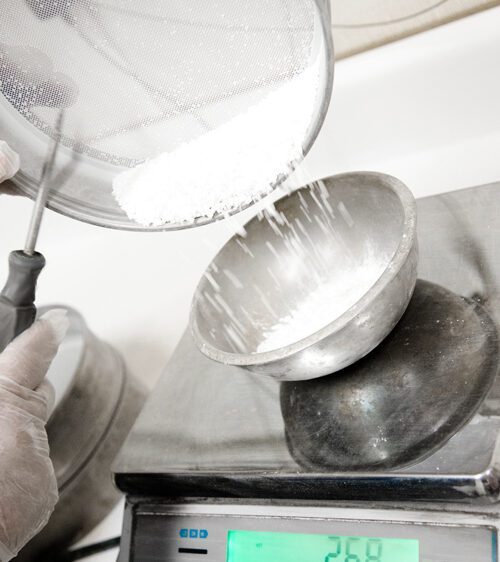
In powder-based manufacturing, particle engineering rarely gets the spotlight, but it should. Whether you are processing polymer additives, industrial non-hazardous chemicals, or specialty food ingredients, the size, shape, and distribution of particles can make or break your product’s performance. At Toll Compaction, particle engineering is at the core of our dry granulation and classification services, helping clients achieve optimal flowability, compressibility, and consistency across a wide range of materials.
Uniformity and Process Reliability Across Industrial Applications
One of the key benefits of particle engineering is its ability to enhance uniformity and process reliability. In polymer additive manufacturing, inconsistent particle sizes can lead to poor dispersion in compounding applications and uneven performance in end-use materials. For industrial chemical producers, variability in particle size distribution can affect reactivity, handling characteristics, and product yield. Toll Compaction addresses these challenges with precision roller compaction and advanced screening systems, tailoring particle size distribution to meet exact material and process requirements. This ensures that every batch performs reliably across the full range of industrial applications we serve.
The Same Discipline Applies Across Every Material We Process
For functional food ingredients, excipients, and dietary supplement components, which make up a portion of our production work, the same particle engineering principles apply. Precise control ensures accurate ingredient delivery, consistent dosing, and reliable dissolution. But the underlying value is consistent whether you are producing a polymer additive or a food-grade ingredient: engineered particles outperform uncontrolled ones every time.
How Dry Granulation Improves Process Efficiency
Engineered particles flow more smoothly through equipment, reducing downtime, dust generation, and material loss. Toll Compaction’s dry granulation process, which avoids the use of liquids and drying steps, is especially beneficial for moisture-sensitive materials common in both chemical and food ingredient applications. Our facilities in New Jersey and West Virginia are designed to handle a wide range of materials with dedicated rooms to prevent cross-contamination, ensuring both quality and compliance at every step.
Partner with Toll Compaction for Precision Particle Engineering
Particle engineering is more than a technical detail. It is a strategic tool for product success across industries. By partnering with Toll Compaction, manufacturers can fine-tune their formulations and processes, scale production with confidence, and bring high-performing materials to market faster. In a competitive landscape, the difference between good and great often comes down to particle-level precision that your downstream processes and end customers will notice.
Ready to put precision particle engineering to work for your product? Contact Toll Compaction today to discuss your project and request a quote.


